
Ellsworth County Court Records After Arrest
After an Ellsworth County arrest, the first official record is usually the jail booking handled by the Ellsworth County Sheriff's Office. The court case is a different record set. The Ellsworth County Attorney, Paul J. Kasper II, reviews law-enforcement reports and decides whether to file formal charges in Ellsworth District Court. Once charges are filed, the case record can show the charging document, hearing dates, bond orders, warrants, amendments, dismissals, pleas, verdicts, and sentencing entries.
The local court office is Ellsworth District Court at 210 N Kansas Ave, Ellsworth, KS 67439. The clerk is Kristy Battershell, the public email is EW.DCPublic@kscourts.gov, and the phone number is 785-472-4052. Court records after a jail arrest should not be treated as the same thing as jail custody data. Custody and booking details belong with Ellsworth County jail inmate records, while formal filed charges live in the court case. Booking-photo questions belong with Ellsworth County jail mugshots because the court file is not a county photo gallery.
The Ellsworth County Attorney works from the courthouse basement at 210 N Kansas, Ellsworth, KS 67439, phone 785-472-4244. That office prosecutes local criminal cases. It does not mean every arrest turns into the same filed charge. A booking allegation can be declined, amended, reduced, replaced by a different count, or filed with added counts after more facts are reviewed.
Find Ellsworth County Court Records
Kansas Judicial Branch CaseSearch is the statewide portal for public district court case information. Research confirmed public search references for case number and party name. Automated inspection was blocked during research, so the safest workflow is to use the live CaseSearch portal for the online search and fall back to the Ellsworth District Court clerk or courthouse terminal when an online result is missing, incomplete, sealed, older, or hard to match.
- Start with the person's full name, date of birth if known, and approximate arrest date from the sheriff or jail.
- Search Kansas CaseSearch by party name. If a case number is already known, use it because it narrows the result set.
- Open the matching district court case and read the filed charge list, hearing entries, bond orders, warrant entries, and disposition fields.
- Call or email the Ellsworth District Court clerk if the name search returns no result, if several people share the same name, or if the case appears restricted.
The Kansas Judicial Branch district court records overview says public court records can be searched online and at courthouse terminals. For Ellsworth County court records after a jail arrest, the courthouse fallback matters because the official county research did not find a local sheriff case-search page or an online warrant list. CaseSearch is the court route, not a county jail roster.
The official Kansas CaseSearch landing page is the statewide entry point for public district court case information.
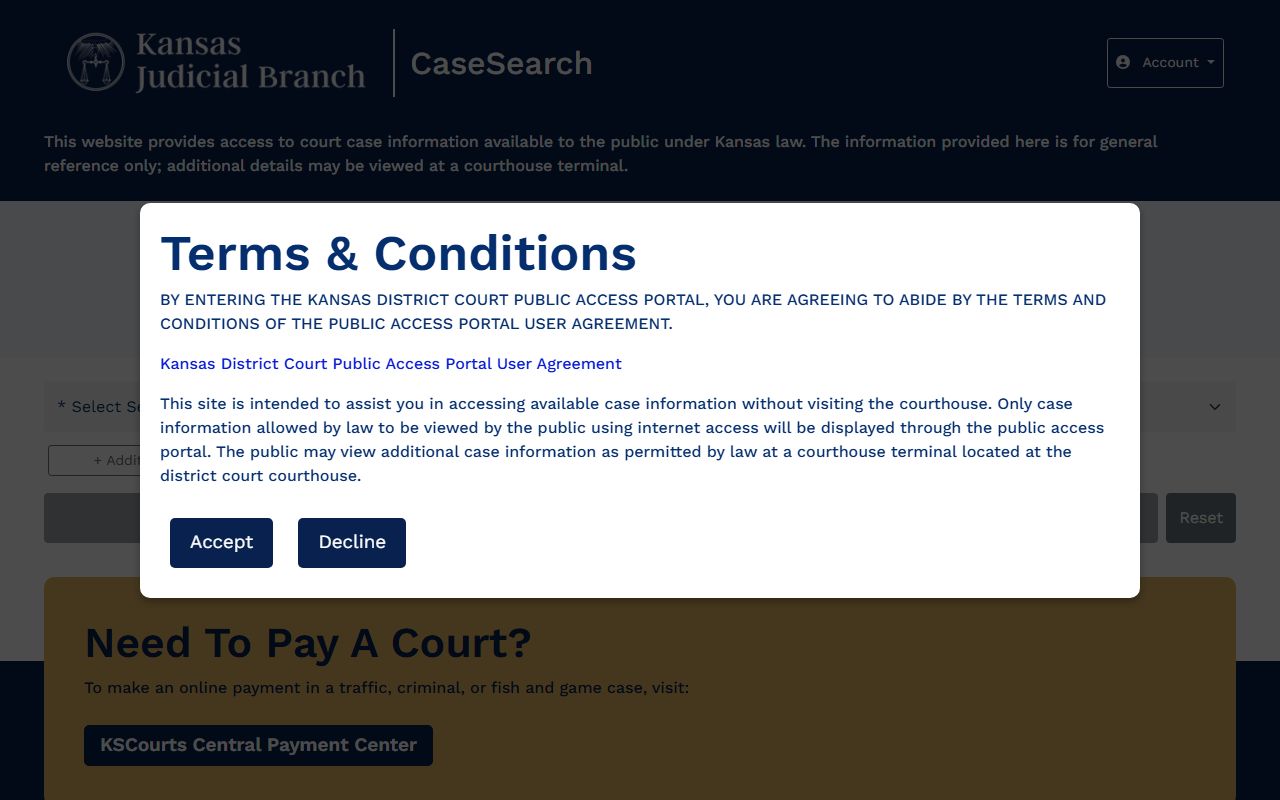
Use the portal for public case lookup, then verify uncertain matches with the Ellsworth District Court clerk because party-name searches can produce more than one possible case.
Ellsworth County CaseSearch Fields
The research file captured only the public search fields that could be verified without bypassing access controls. That means the table below is intentionally narrow. It reflects the official route that was confirmed: search by case number when known, search by party name when only a defendant name is known, and use the clerk or courthouse terminal for records that do not display online.
| Field Label | Type | Required | Notes |
|---|---|---|---|
| Case Number | Text | Optional | An exact case number is the best way to narrow Ellsworth County court records after an arrest. |
| Party Name | Text | Optional | Use the defendant name. Spelling, middle initials, and suffixes can affect matching. |
| Other Filters | Unspecified | Unspecified | Automated inspection was blocked, so check the live CaseSearch portal for current filter options. |
CaseSearch is not the same as KASPER. KASPER is a Kansas Department of Corrections tool for people sentenced to KDOC custody or supervision. Kansas VINE is a county-jail custody notification system. A court case may exist while a person is in the Ellsworth County Jail, out on bond, moved to KDOC, or no longer in custody.
Charges Filed After Arrest
The arrest starts the custody side. A charging document starts the court side. In Ellsworth County, the County Attorney reviews reports from the sheriff, Ellsworth Police Department, Kansas Highway Patrol, or another arresting agency and files charges in district court when prosecution is appropriate. The exact document name depends on the case and procedure. The key point is that the court records after a jail arrest begin with the formal filing, not with the booking label alone.
| Charging Document | Who Files or Issues It | What It Does | Ellsworth County Use |
|---|---|---|---|
| Complaint | Prosecutor or law-enforcement-backed filing | States the alleged offense and starts many criminal cases. | Common first court document after a local arrest. |
| Information | County Attorney | Sets out formal charges after prosecutor review. | Used when the prosecutor files or refines charges in district court. |
| Indictment | Grand jury | Charges a person through a grand-jury process. | Less common in routine local jail-arrest cases. |
The court file may also contain bond orders, probable-cause findings, appearance entries, warrant returns, continuances, plea entries, sentencing entries, or dismissal orders. A jail booking may show the arresting allegation, but the charging document is what tells the court what count or counts the defendant must answer.
Ellsworth County Charge Status
Charge status can change several times between arrest and final disposition. A charge may be pending at first appearance, amended after more review, reduced through a plea agreement, dismissed by the court, or replaced by a different filed count. That is why Ellsworth County court records after a jail arrest should be checked again after the first filing if the case is still active.
| Status | What It Means | Record Caution |
|---|---|---|
| Pending | The charge is active and has not reached a final court outcome. | Do not treat a pending charge as a conviction. |
| Amended or Reduced | The filed count changed, often after prosecutor review, plea talks, or court action. | Compare the current count with the original filing before drawing conclusions. |
| Dismissed | The court or prosecutor ended the charge without a conviction on that count. | The arrest and case entry may still appear unless access is restricted or expunged. |
| Nolle Prosequi | The prosecutor chose not to proceed on that charge. | Verify whether other counts in the same case remain active. |
| Disposed | The count has a final result, such as plea, verdict, dismissal, or sentencing. | Read the disposition entry, not just the charge title. |
Bond After Ellsworth County Arrest
No Ellsworth County jail bond page or fee schedule was located. After an arrest, bond may come from a statute, warrant, bond schedule, or judge at first appearance. The practical local route is to call the Ellsworth County Jail at 785-472-4416 before bringing money and ask for the exact bond amount, case number, payee, payment method, posting location, hours, and whether any hold prevents release.
| Bond Type | How It Works | What to Confirm Locally |
|---|---|---|
| Cash Bond | The full amount is paid as required by the court or jail process. | Ask who the payee is and where payment is accepted. |
| Surety Bond | A licensed bail bond agent posts bond for a fee. | Ask whether surety is allowed for the case and whether holds exist. |
| PR or Own Recognizance | The person is released on a written promise and court conditions. | Read all return-date and release-condition terms in the court order. |
| No-Bond Hold | Release is blocked until a judge or another agency clears the hold. | Ask whether the hold is local, out-of-county, probation, parole, federal, or immigration related. |
If the bond is tied to a district court case, verify the case status with the Ellsworth District Court clerk at 785-472-4052. A person may have a local bond and still remain in custody because of a detainer. A detainer is a hold request from another agency or jurisdiction.
Warrants and Court Records
No official Ellsworth County active warrant search form, warrant list, or most-wanted database was located in the research. The sheriff's page says deputies execute warrants, so the sheriff at 785-472-4416 is the practical contact for active arrest-warrant custody questions. Bench warrants and failure-to-appear warrants are court orders, so the District Court clerk may also need to confirm the case record.
Warrants may be arrest warrants, bench warrants, search warrants, out-of-county warrants, probation or parole holds, or federal warrants. A warrant arrest can place a person in the Ellsworth County Jail if the jail accepts the booking. The court records after that arrest may show the warrant case number, issuing court, bond amount, warrant return, and next hearing. Do not try to clear an active warrant based only on a web result. Contact an attorney or the court before appearing.
Charges vs Convictions
An Ellsworth County arrest and a filed charge are not the same as a conviction. A charge is an accusation placed before the court. A conviction requires a guilty plea, no-contest plea accepted by the court, or finding of guilt. Court records after a jail arrest should be read by stage, because the meaning of the record changes as the case moves.
| Charge | Conviction | |
|---|---|---|
| Stage | Accusation filed in court after arrest or investigation. | Final guilty outcome by plea or verdict. |
| Proof Level | Based on filing standards and probable cause. | Requires proof beyond a reasonable doubt or a valid plea. |
| Public Meaning | Shows what the prosecutor alleged. | Shows what the court found or accepted as guilt. |
| Record Use | Needs status and disposition checked. | Still needs sentence, appeal, and expungement status checked. |
Sealed vs Expunged Records
Kansas Open Records Act rules make public records open unless another law applies. At the same time, some court records after an arrest may be restricted because of juvenile status, sealing, expungement, victim or witness safety, an ongoing investigation, or another statutory exception. K.S.A. 45-221 lists records that public agencies are not required to disclose, and the research notes annotations involving law-enforcement records, jail books, standard offense reports, and mug shots.
| Sealed | Expunged | |
|---|---|---|
| Basic Effect | Public access is blocked or limited by court order or rule. | Eligible records are legally limited from ordinary public access after court action. |
| Who May Still See It | Access may remain for courts, law enforcement, or parties allowed by law. | Access may remain for certain official uses allowed by Kansas law. |
| How to Check | Contact the Ellsworth District Court clerk if the case cannot be viewed online. | Ask the clerk about the case status and the required court process. |
Expungement is not automatic just because a charge was dismissed or a person was released from jail. The exact outcome should be verified through the court file, not through a jail booking entry or an old search result.
Restricted Ellsworth County Court Records
K.S.A. 45-215 names the Kansas Open Records Act. K.S.A. 45-216 states the open-records policy, while K.S.A. 45-218 and K.S.A. 45-220 address inspection procedures and custodian duties. For jail and law-enforcement records, K.S.A. 45-221 is important because it lists exceptions and includes annotations tied to law-enforcement records, jail books, standard offense reports, and mug shots.
Restricted records are not errors in the search system. Juvenile matters, sealed cases, expunged records, ongoing investigations, sensitive victim or witness information, and some law-enforcement files may be withheld or redacted. When a CaseSearch result is missing but the arrest is known, the next step is the Ellsworth District Court clerk, not an unofficial third-party page.
Important: Court lookup details cannot be used for employment, housing, credit, insurance, or other FCRA-covered screening.
Public Record Search
Sponsored Results